Published on Tuesday, 31 March 2026 at 3:34:13 PM
For many residents of Shire of Mundaring, sharing our leafy landscape with wildlife is part of what makes living in the Perth Hills so special. Among our most common nocturnal neighbours are possums – curious, adaptable and, at times, a little noisy when they decide your roof space is the perfect place to sleep.
It’s worth remembering that possums are protected native animals. In Australia, it is illegal to harm, harass or relocate them without appropriate approvals and penalties can apply. These protections reflect an important reality: possums are hollow-dependent species, and natural tree hollows can take over a century to form. As bushland has been cleared for homes, sheds and roads, suitable denning sites (the place that a nocturnal animal sleeps during the day) have declined dramatically – so our roofs have, quite understandably, become an attractive substitute.
Our possums are simply making use of the habitats we have replaced, so our goal should be coexistence, by gently encouraging them to move somewhere more appropriate rather than removing them from your property. Common brushtail possums are highly territorial, maintaining defined home ranges and den sites that they defend from others. In areas like the Perth Hills, where suitable hollows are limited, most available habitat is already occupied.
Local wildlife educator Simon Cherriman, through his Re-Cyc-Ology Project, promotes a practical and humane solution: provide an alternative home first. Installing a well-designed nest box in your garden or nearby bush can give possums a safe place to go. In fact, many people find that once a suitable box is available, possums willingly relocate, sometimes even raising young there for several seasons.
If a possum has taken up residence in your roof, a staged and ethical exclusion process is recommended:
- Provide an alternative shelter such as a nest box, ideally installed a few metres above the ground in a suitable tree. Do this at least a week before you start blocking access to your roof to allow the possums to find it.
- Identify where the possums are entering your roof and block it with wire mesh or wooden panel but leave one spot open that the possums can continue to use it until you are ready to completely block it off. This can be a big job and can be done in stages.
- Wait until the possum has left at night, then carefully seal entry points to prevent re-entry. Possums will work hard to get back in so be prepared to have a few attempts at a complete seal off.
- Consider pruning any limbs that are in contact with your house to limit any future access.
This approach ensures the animal is not trapped inside and reduces stress or harm. It also addresses the real issue of access rather than simply moving the problem elsewhere and then potentially having another possum move in.
In the Perth Hills, where mature trees and remnant bushland still exist, residents are uniquely placed to support wildlife. Retaining large trees where possible, planting for habitat, and installing nest boxes can all help restore the hollows that species like possums depend on.
Living with possums may require a little patience, especially when the footsteps echo across the ceiling at night. But with a thoughtful approach, it’s possible to protect your home while also respecting the native animals that call this landscape home long before we did.
If you want more information Simon’s book ‘Hollowed Out?’ is available in our libraries and provides excellent information on creating your own nest-boxes and the creatures that depend on tree hollows.
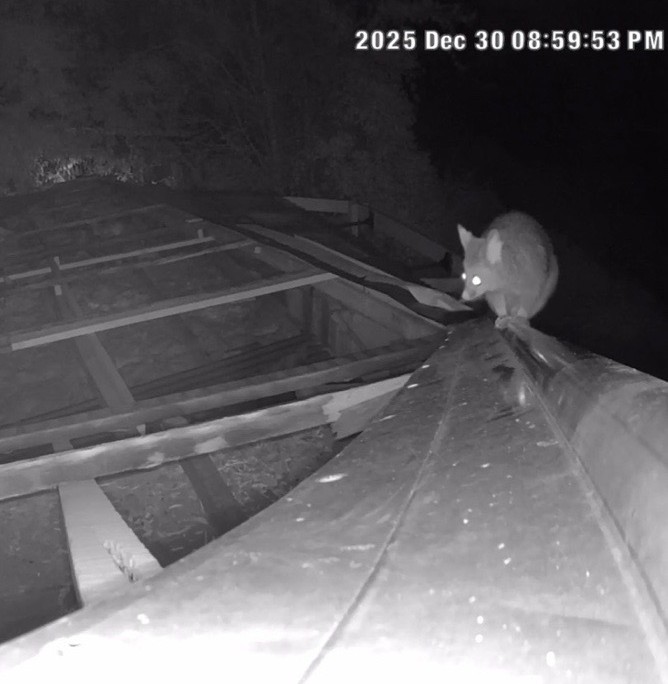
Case study: Shire resident Ben’s experience
Local resident Ben Ward has spent more than a decade sharing his home with some very persistent possums.
“We have lived in our home for 13 years and have had them since day one,” Ben said.
“Some years were worse than others, but after some sleep deprivation and minor damage to our ceilings, I finally took major steps to keep them out.”
Ben’s biggest concern was whether any solution would actually work.
“It can be really disheartening to try everything and still have them come back… I was worried they’d cause serious damage, electrical or structural.”
To better understand the problem, Ben installed cameras to track possum movements.
“The cameras sent alerts to our phones, allowing us to monitor them each night.”
What followed was a thorough, hands-on approach. Ben removed sections of the roof and physically blocked every entrance. He also sealed access points under the house, often working late into the night.
“It was the only way I could keep them out. You just have to persist. That’s the hard part.”
Importantly, Ben paired exclusion with a humane solution.
“We built three boxes in nearby trees and they have now relocated there, which is a great feeling.”
Ben shared the following advice from his years of trail and error.
“Nothing works like blocking them out and providing an alternative. The cameras are also relatively cheap from Bunnings, so you don't have to sit up all night listening and watching for where they're getting in and out.”
“Trapping and releasing is not the answer, they'll just come back and it's distressing for them. Poisons are also cruel and unnecessary. They are not the answer. They were here first and they are a protected part of our ecosystem.”
For those facing similar challenges, Ben encourages patience and practical action.
“Investigate and monitor your house to understand what’s really happening and don’t be afraid to seek help if you need it. Or learn to live with them on your property, just as long as they are not in your walls or roof causing damage.”
Back to All News