Page Title
Millions of Australian households are making the switch to electric homes for heating, cooling, cooking, water heating and transport. Choosing electric appliances and vehicles can help reduce energy bills, protect the health of the people in your home, and is one of the fastest ways to reduce household emissions.
The transition to renewable energy is happening, in WA renewables accounted for 55% of energy on the South West Interconnected System in November 2025. This percentage will continue to increase, and as more renewables join the grid, electricity is becoming cleaner to use.
Changing the ways our homes use energy doesn’t need to happen overnight, but it’s time to think about when a suitable opportunity might be. The next time you need to replace a fuel burning machine, choose electric. Make a plan so that when your appliances die, you renovate or when it’s the right time, you’ll be ready to replace appliances and vehicles with efficient electric ones.
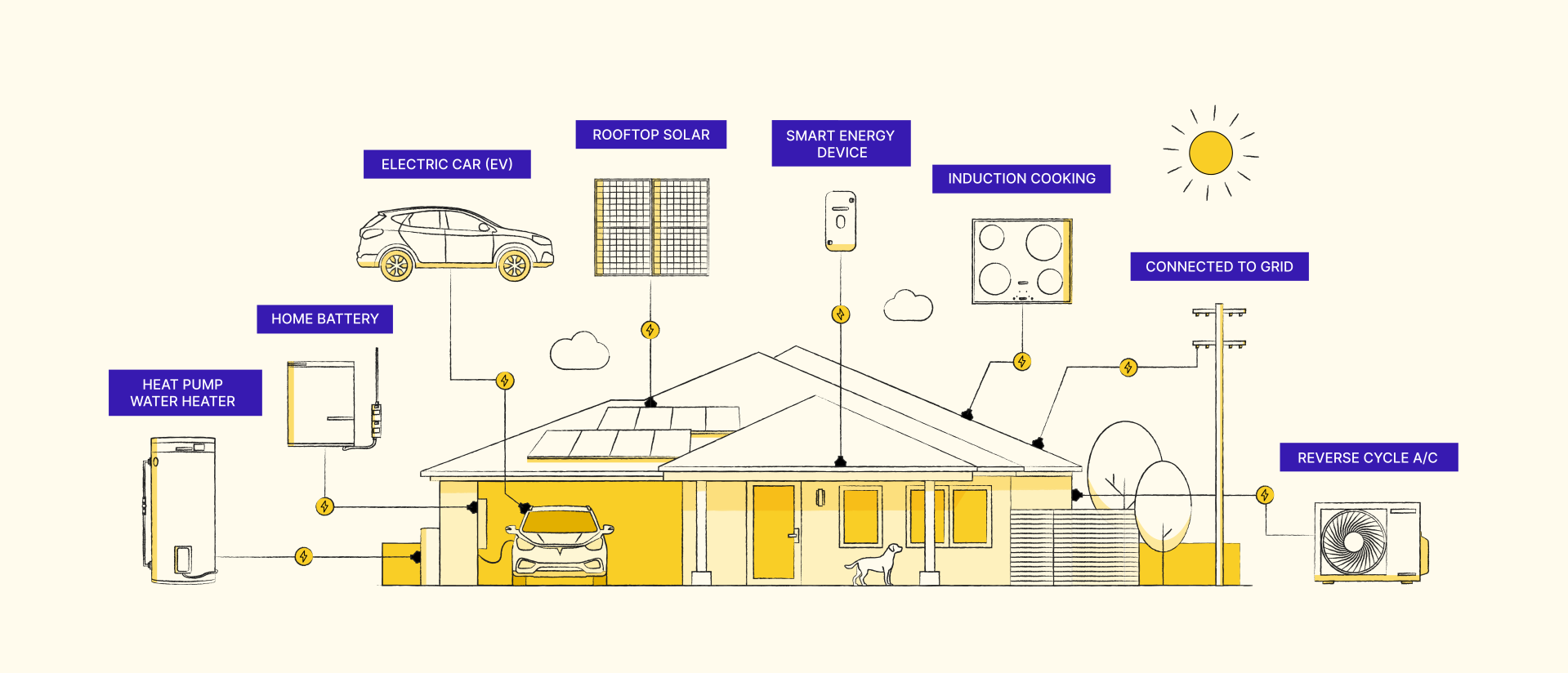
Image credit: Electrify Everything
Elements of an all-electric home
Rooftop solar and renewable energy
Australia's rooftop solar is the world's cheapest delivered energy, which brings enormous savings when powering your home. Solar panels convert sunlight into free electricity for use in your home. In December 2025 approximately 57% of houses in the Shire of Mundaring have some form of photovoltaic system installed.
For more details, explore:
If your unable to install rooftop solar, consider GreenPower, which is the purchase of renewable electricity to power your home. It is government accredited and supports the increase of renewable energy in the Australian grid
Home battery
A home battery stores excess energy from your rooftop solar so you can power your home using this energy at night or on cloudy days. Storing your rooftop solar for use at night and low solar production times means you can lock in ongoing energy savings and be more energy independent.
For more details, explore:
Electric space heating
Heating and cooling your home accounts for 40% of average household energy use. Reverse cycle air conditioners are the most efficient way to heat your home in winter and cool it in summer. Reverse cycle air conditioning can be a single unit (cheapest to run), multiroom units or ducted and is 3-4 times more efficient than electric heater or a gas space heater.
For optimal benefit and efficiency chose a model with low or ultra-low Global Warming Potential refrigerants, clean filters every six months and keep thermostat to 18-20°C in winter and 23-25°C in summer.
For more details, explore
Electric water heating
Heating water accounts for 20% of average household energy use. Electric heat pumps use 3-4 times less energy than gas hot water systems and can be timed to utilise your rooftop solar production.
For more information explore
Electric cooking
Induction cooktops use electromagnetic energy to heat food. They offer safer, faster and more efficient cooking than gas cooktop. Most importantly, induction cooktops do not emit toxins that are harmful to health. Induction cooktops use less energy, have greater temperature range and are easier to clean. If a magnet sticks to your cookware then it is compatible with induction cooktop.
For more details, explore:
Electric vehicle
Electrifying your vehicle can bring in the biggest emissions reductions and bill savings for your household. Electric Vehicles (EVs) are better for our health and the environment compared to traditional internal combustion engines (ICE) vehicles. EVs are quieter to drive, reduce noise pollution and have no tailpipe emissions which means they don't release pollution into our communities which is better for our health and environment.
When we look at the full lifecycle emissions of different types of cars, which includes the emissions to manufacture the vehicle, run it and the end-of-life recycling and disposal, on average EVs reduce emissions by around 40% to 50% compared to similar petrol/diesel models, and around 25% compared to hybrid vehicles. Emission savings can be further increased when EVs are primarily charged using renewable energy.
Options like e-bikes and e-scooters can make a fun, cheaper and healthier alternative to a car or second car.
In 2023/2024 the Shire of Mundaring community generated 74,000 (tCO2e) automotive emissions. Electric vehicles are part of our shift to a low-carbon future. If renewable energy is used to recharge the battery, electric vehicles have zero on-road emissions.
For more details, explore:
Through the Switch Your Thinking Program, Shire of Mundaring residents and businesses have access to discounts on solar panels and inverters, solar battery storage systems, hot water heat pumps, EV chargers and more. Check out the Rewards for Residents and Rewards for Business for more details.
Related pages
Energy Efficiency in the Home
More information and contact
More information and guidance on electrification is provided through the following documents and links:
Electrify Everything Go All Electric Planner
Electrify Everything
Rewiring Australia
Climate Council saving calculator to find out how much you could save by getting off gas
Renew’s Getting Off Gas Toolkit
For more information contact the Environment and Sustainability Team on (08) 9290 6770 or email shire@mundaring.wa.gov.au.