Page Title
FOGO stands for Food Organics and Garden Organics. Your lime green-lidded FOGO bin, collected weekly, is for:
- Food organics
- Garden organics
- Certified compostable caddy liners only
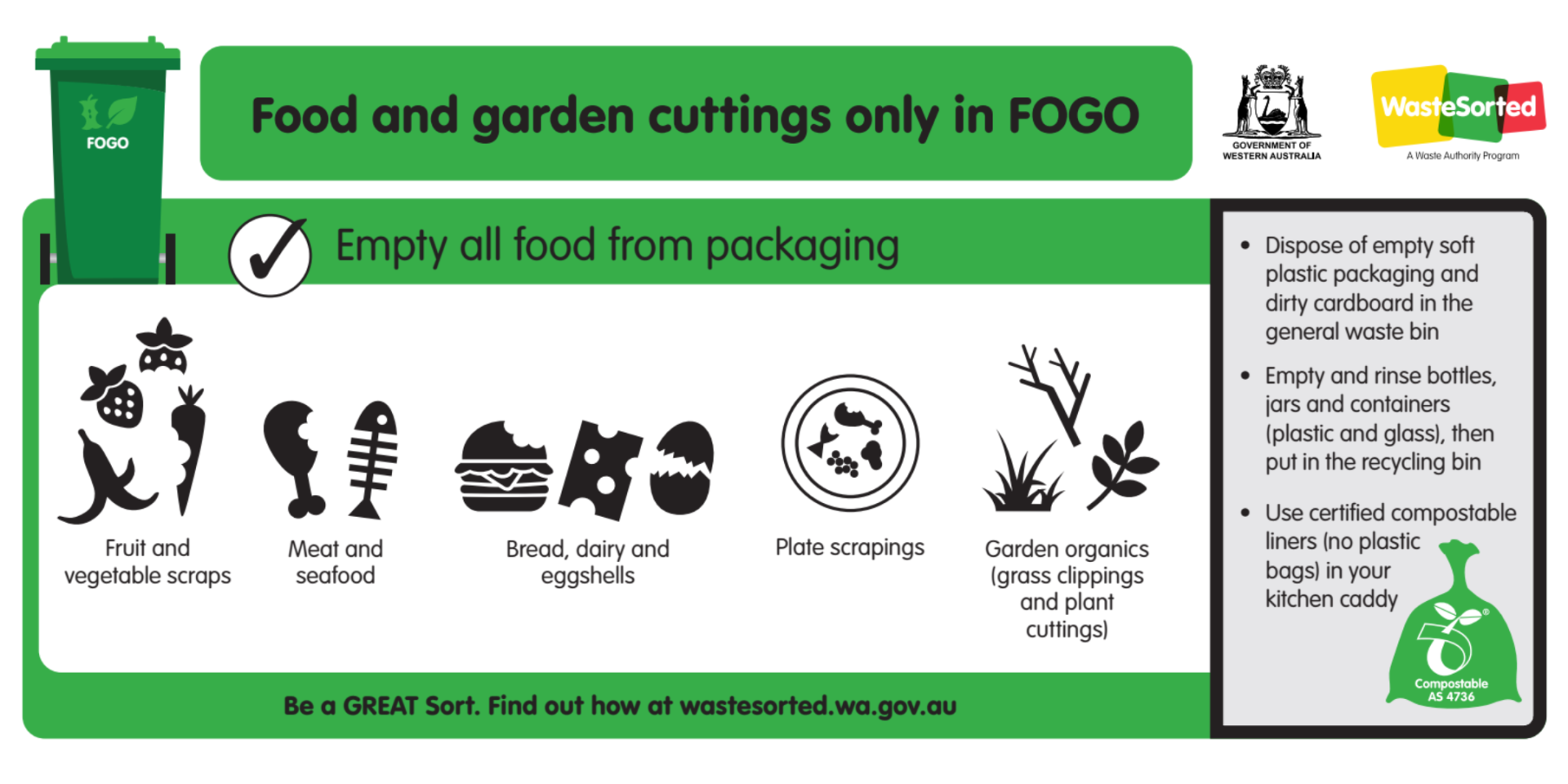
The Shire of Mundaring introduced the Food Organics and Garden Organics (FOGO) bin to households in 2024 as part of the Better Bins Plus: Go FOGO program.
In July 2026 Western Australia updated its FOGO guidance to help create cleaner compost and improve environmental outcomes. Keeping the FOGO accepted list simple makes sorting waste easier and helps produce high-quality compost for farms, parks and gardens. The Shire will go through a transition period as it implements the updates FOGO accepted list and is planning communications to be released over the coming months to help our community understand the latest updates to FOGO.
The Frequently Asked Questions (FAQs) below help to explain the three-bin FOGO system.
About the FOGO system FAQs
Why do we have FOGO?
FOGO (Food Organics and Garden Organics) helps reduce the amount of waste sent to landfill. Under the previous two-bin system around half of what went into the red lid general waste bin was organic material that could have been composted instead of buried. When organics break down in landfill, they produce methane, a greenhouse gas 25 times more harmful than carbon dioxide.
The Western Australian Government required all councils in Perth and Peel to introduce FOGO by 2025 and has set a target for 75% of waste to be diverted from landfill by 2030. The Shire planned its FOGO transition since 2020 and Council approved the move to FOGO in August 2023 as part of its commitment to sustainability and reducing greenhouse gases.
Although many residents already compost at home or keep chickens, audits of the previous two-bin systems showed that more than 50% of general waste bins still contain compostable material. By collecting food and garden waste separately, the FOGO bin allows this material to be recovered and turned into compost instead of going to landfill.
Do other local councils have FOGO?
As of May 2026 there were 27 local governments (including the Shire) in WA with a three-bin FOGO system in place.
Why is FOGO important?
Food organics and garden organics make up a large proportion of household waste. FOGO helps divert these valuable materials from the general waste bin so they can be turned into compost and other recycled organic products. Separating food scraps and garden waste also leaves more space in the general waste bin for items that can’t be recycled or composted.
Products like compost can then be used in farms, parks, gardens and landscaping projects, returning nutrients to the soil and supporting healthy plant growth. FOGO is helping Western Australians recover valuable resources and reduce waste to landfill, supporting a more sustainable future for our communities.
Read the Waste Authority’s position statement on FOGO.
What happens to my FOGO after it’s collected?
Your food scraps and garden waste go to a licensed facility where they are turned into recycled organics, such as certified compost. The facility processes the organic material to meet Australian Standard AS 4454 for soil safety and quality.
These products are sold for use in agriculture, urban amenity uses such as landscaping or use by local governments and households.
Watch how your FOGO is turned into compost here: Where your FOGO waste goes: the journey from bin to compost
Who decides what can go in the FOGO bin?
The WA Local Government Association (WALGA)'s Consistent Communications Collective (CCC) with representatives from local government, waste industry and State Government, maintains the “Agreed List” for FOGO inputs, along with other kerbside bins. This can be found at recycleright.wa.gov.au/a-z.
The CCC collaborates to keep the list consistent, simple and aligned with national standards.
Your local government is responsible for local kerbside collection services. Local governments and organics processors are bound by State regulations, facility licence conditions, Australian Standards and individual contractual arrangements, which determine the exact guidance for your local area.
FOGO and Your Household FAQs
What is the standard bin service?
The Shire's standard household bin service is the three-bin system:
- 240 litre lime green FOGO bin collected weekly: for food scraps and garden organics.
- 240 litre yellow recycling bin collected fortnightly: for cans, plastic, glass, paper and carboard, lids off, rinsed and loose.
- 140 litre red or dark green lidded bin collected fortnightly (alternating with recycling bin): for general rubbish items that can't be recycled or composted and will be sent to landfill.
I already compost, use Bokashi or have a worm farm at home, do I need a FOGO lime-green lid bin?
You can continue to use your compost bin, Bokashi bin or worm farm.
You can use your FOGO bin for items you can’t put in your home compost bin such as bones, meat and seafood. If you use Bokashi, you can put the material from the Bokashi bin into the FOGO bin after it has composted (if you have nowhere to bury it).
You are still able to use your lime-green lid kerbside bin for garden waste, along with food waste, which will continue to be useful for residents with gardens, once the material has been composted. Worms can also be fussy eaters and often don’t like onion, citrus, and potato peel and other organic materials that can go in your FOGO bin.
How to use your FOGO bin FAQs
What can I put in my FOGO bin?
Your FOGO bin is for food organics, garden organics and certified compostable caddy liners only.
Food organics
- Vegetable and fruit scraps
- Meat scraps
- Seafood
- Bread
- Dairy products
- Eggshells
- Loose tea leaves and coffee grounds
- Plate scrapings
- Out-of-date food (unpackaged)
Garden waste
- Grass clippings
- Plant cuttings
- Leaves
- Flowers
- Weeds
- Small branches
- Twigs
Certified compostable caddy liners
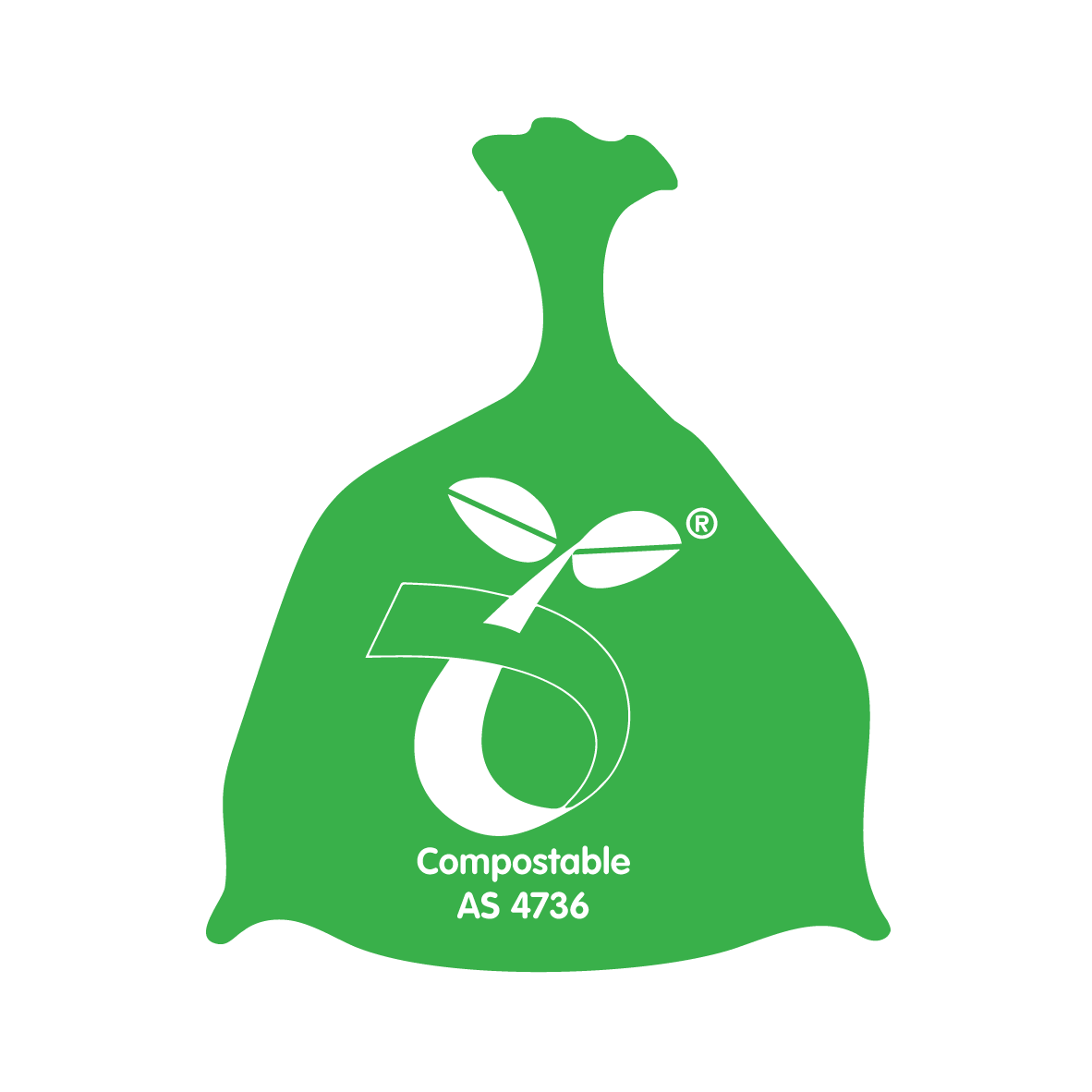
- You can use council-supplied liners, supermarket fruit and veg produce bags with the logo or purchase your own certified compostable bags. Make sure you look for AS4736 and the seedling logo like below.
What should I do with tissues, paper towels, pizza boxes or tea bags?
These items should go in your red-lidded general waste bin.
You can also choose low-waste options, such as trying reusable alternatives for tissues, paper towels and single-use takeaway containers or switching to loose-leaf tea.
What should I do if I’m not sure where something goes?
Three-bin FOGO systems in Western Australia have three simple streams:
- FOGO bin (lime-green lid): food scraps, garden waste and certified compostable caddy liners
- Recycling bin (yellow lid): clean paper and cardboard, cans, plastic bottles and containers, glass bottles and jars
- General waste (red lid): soft plastics, animal droppings, nappies, soiled paper/cardboard and general rubbish
The Recycle Right website can help you find out which bin to put things in. Visit recycleright.wa.gov.au/a-z or contact your local government.
How can I reduce moisture in my FOGO bin?
Let hot food cool before placing it in the caddy. Warm or freshly cooked food releases steam, which adds moisture to your bin.
Drain excess liquids from food scraps before disposal, where possible. Empty your kitchen caddy regularly and keep your outside bin clean, dry and in the shade.
A light sprinkle of bicarb soda in your caddy or bin liner can help absorb moisture and reduce smells. Adding dry leaves to your outdoor bin can also help soak up excess liquid. Freezing wet or high moisture scraps and placing them in the bin just before collection is another effective way to reduce moisture and odour, especially during warm weather.
How can I reduce odours in my household bins?
A few small changes can help reduce household bin odours, including in hot weather. Bag and tie items such as nappies, animal droppings and hygiene products before placing them in the general waste bin, and store bins in a shaded area where possible.
Empty your kitchen caddy regularly, keep your outdoor bins clean and dry, and place wet food scraps in the FOGO bin as close as practical to collection day.
For more practical tips, you can refer to the Managing Odours Informational flyer.
Kitchen caddy FAQs
How do I use my kitchen caddy?
The kitchen caddy is a small countertop style bin with a lid and handle, designed to be kept on your kitchen bench for collecting your food scraps.
To use your caddy, insert a provided compostable liner and start collecting your kitchen scraps such as vegetable peels, meat scraps, eggshells etc. After 2-3 days, or once the liner is full, tie a knot in the top to seal it and transfer the liner and its contents into your FOGO kerbside bin (lime-green lid). Put out the FOGO bin for weekly collection on your normal bin day. Using a compostable liner will reduce the need to wash the caddy and reduce odours. You can place your garden waste directly into the lime-green lid kerbside bin, along with your food waste.
Can I line my kitchen caddy with newspaper or paper towels?
No. Newspaper, paper towels and other paper products are no longer accepted in FOGO. Some paper and cardboard products may contain PFAS and other chemicals. To help keep FOGO clean, paper and cardboard products are no longer accepted.
If you want to line your caddy, use certified compostable caddy liners with the AS 4736 seedling logo. These are accepted in FOGO because they are designed to specifically help households collect food scraps and have been assessed as suitable for use in FOGO systems.
What do I do once my compostable caddy liners run out?
Every 12 months you are eligible for two more rolls of liners free of charge on proof of residency. Effective 1 July 2025, year-round collections are available.
Please remember to bring your Community Recycling Centre Pass with you when collecting from one of the following venues:
- Mundaring Community Recycling Facility, Coppin Road, Mundaring
- Chidlow Community Recycling Facility, Mathieson Road, Chidlow
- Shire Administration Centre – 7000 Great Eastern Highway, Mundaring Monday to Friday 9am to 4.30pm.
Check Community Recycling Centre opening hours.
You can also purchase your own compostable liners from supermarkets – please note the bags must be certified compostable (AS 4736). Look for the compostable logo!
Can I use a plastic bag, or bags marked 'degradable' or 'biodegradable' to line my kitchen caddy?
No. Plastic bags, including degradable and biodegradable bags, will contaminate the FOGO bin, as they are not compostable - they are essentially plastics that decompose faster than a traditional plastic bag but eventually break down into microplastics (very small pieces of plastic) that can pollute the environment.
Instead, place only bags marked as certified compostable caddy liners with the AS 4736 seedling logo, in your lime-green lid FOGO bin. Or as an alternative, you can place food waste directly into the FOGO bin.
Why does the information on my bin lid or kitchen caddy show different information?
You might notice that information on your bin lid, kitchen caddy or older materials looks different to what you see online or in newer guides. This is because advice has been updated over time.
Some older bin stickers were created using earlier advice, while newer guides reflect the current, simpler FOGO guidance designed to reduce contamination and create cleaner compost.
Related pages
Circular Economy
Earth-cycling
How To Use Your Bins
More information and contact
More information and guidance on FOGO is provided through the following documents and links:
FOGO | WasteSorted
Western Australia FOGO guidance - Towards cleaner compost July 2026
Check my bin collection dates
For further information, please contact the Shire of Mundaring on (08) 9290 6666 or email shire@mundaring.wa.gov.au.